
Updates from the March 23, 2026 Council Meeting
At the March 23, 2026, Ocean Protection Council (OPC) meeting, the Council unanimously approved more than $12.5 million in investments to advance sea level rise adaptation planning and tribal cultural resilience, make meaningful progress to conserve 30% of California’s coastal waters by 2030 (30×30) to protect coastal and marine biodiversity, and strengthen adaptive management of the state’s Marine Protected Area (MPA) Network. Together, these investments advance the goals of OPC’s newly adopted 2026–2030 Strategic Plan: Safeguarding Our Coast and Ocean for All Californians and reflect the Council’s steadfast commitment to equitable, science-based stewardship of California’s coast and ocean.
The Council, in partnership with the California Ocean Science Trust, also released the 2026 California Coast and Ocean Report – the first comprehensive, science-based assessment of coastal and ocean health in California history. The Council additionally held two informational items on new science-based guidance to inform coastal and marine restoration and on the statewide expansion of the Protecting Blue Whales Blue Skies Program.
Key Action Items
- SB 1 Sea Level Rise Adaptation Planning Grant Program (Track 1): Up to $1,890,724 was approved for four sea level rise adaptation planning projects across California’s coast and San Francisco Bay:
- City of Crescent City: Up to $320,911 for the “Crescent City Coastal Resiliency Plan”
- City and County of San Francisco: Up to $664,000 for the “San Francisco Outer Coast Sea Level Rise Adaptation Plan”
- City of American Canyon: Up to $383,070 for the “American Canyon Sea Level Rise Adaptation Plan”
- County of Napa: Up to $522,743 for the “Napa County Sea Level Rise Adaptation Plan”
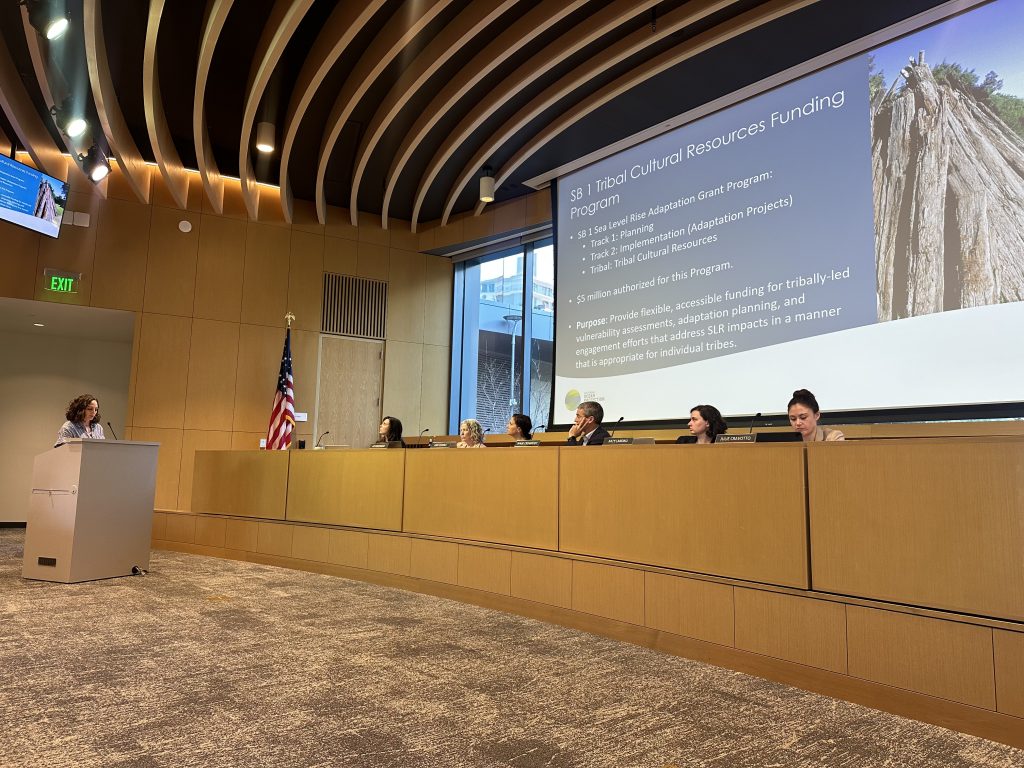
- SB 1 Tribal Cultural Resources Funding Program (Tribal Track): Up to $2,079,859 was approved for the first round of tribally-led projects assessing sea level rise vulnerability and adaptation planning for tribal cultural resources:
- CyArk (on behalf of the yak titẙu titẙu yak tiɫhini Northern Chumash Tribe): Up to $542,976 for “Protecting the Pecho Coast: Northern Chumash Leadership in Climate Resilience”
- Tolowa Dee-ni’ Nation: Up to $748,173 for the “Tolowa Dee-ni’ Coastal Resilience Vulnerability Assessment and Adaptation Plan”
- Kashia Band of Pomo Indians of the Stewarts Point Rancheria: Up to $788,710 for “Protecting Kashia Cultural Resources from the Impacts of Sea Level Rise”
- Advancing 30×30 in Coastal Waters: Up to $6,048,000 to California Sea Grant was approved for nine key science and restoration projects across a range of habitats, selected through a competitive solicitation to advance California’s goal of conserving 30% of coastal waters by 2030:
- Track 1: Action-Oriented Science
- The Nature Conservancy: Up to $988,000 for eelgrass genomics and conservation planning
- University of California, Santa Cruz: Up to $994,000 for identifying multi-species climate refugia along the California coast
- Greater Farallones Association: Up to $502,000 for long-term coastal data analysis
- University of California, Davis: Up to $507,000 for estuary conservation prioritization
- Track 2: Accelerating Environmental Restoration and Stewardship
- The Bay Foundation: Up to $707,000 for kelp forest restoration in the Channel Islands
- Friends of the Dunes: Up to $548,000 for coastal dune restoration
- Occidental College: Up to $367,000 for Malibu coastline recovery following the 2025 Palisades Fire
- National Marine Sanctuary Foundation: Up to $844,000 for eelgrass restoration in the Channel Islands
- University of California, Davis/Bodega Marine Lab: Up to $591,000 for white abalone reintroduction
- Track 1: Action-Oriented Science
- Advancing Adaptive Management of the Marine Protected Area Network: Up to $2,500,000 was approved to advance recommendations from the 2023 MPA Decadal Management Review, including:
- UC San Diego/California Sea Grant: Up to $2,300,000 to administer a competitive Request for Proposals for social science and other priority monitoring needs of the MPA Network
- UC Santa Barbara: Up to $200,000 to expand the SeaSketch California platform for a public, interactive visualization tool of long-term MPA ecological monitoring data
Informational Items
- 2026 California Coast and Ocean Report: Staff and the Ocean Science Trust presented the 2026 California Coast and Ocean Report and accompanying 2026 Coast and Ocean Assessment Methodology, providing a comprehensive assessment of the status and trends of California’s coast and ocean ecosystems, along with the 2025 OPC Annual Report. The report describes not only the pressures facing California’s coast and ocean, but also the historic progress that our state is making to support resilient marine ecosystems and thriving coastal communities.
- Science Guidance for Coastal and Ocean Restoration in California: Staff and the Ocean Science Trust presented the Science Guidance for Coastal and Ocean Restoration in California into a Changing Future, providing strategies and best practices for restoring vulnerable coastal and marine ecosystems.
- Blue Whales Blue Skies Program: Staff, alongside the Santa Barbara County Air Pollution Control District, presented an update on the Blue Whales Blue Skies (BWBS) voluntary Vessel Speed Reduction (VSR) program, including the launch of the 2026 VSR season and inclusion of OPC as an advisor to BWBS consistent with Assembly Bill 14 (AB 14) enacted in January 2026.
Chair Updates and Executive Director Report
California Natural Resources Secretary Wade Crowfoot welcomed State Controller Malia Cohen back to the Council, as Chair of the State Lands Commission, and provided updates on California’s continued opposition to the Trump Administration’s offshore oil drilling proposal, the only stretch of American coastline still targeted after Florida and the Carolinas were withdrawn. He raised concern about a federal executive order directing the restart of the Sable offshore oil pipeline, offline since a 2015 failure that spilled over 120,000 gallons of oil off Santa Barbara, recognizing the restart as dangerous, illegal under state law, and ineffective for lowering gas prices. He also noted that CDFW recently issued its assessment of petitions to amend the MPA network, and that OPC submitted a letter to the Fish and Game Commission affirming the Council’s role as state policy lead as regional meetings on the petitions begin.
Executive Director Jenn Eckerle flagged additional federal proposals with upcoming comment deadlines: hydraulic fracking at Platform Gilda offshore of Ventura County and seabed mining in federal waters. She also highlighted the meeting agenda as a showcase of OPC’s partnership with the Ocean Science Trust, with Items 4, 7, and 8 reflecting the importance of science in underpinning OPC’s work. She announced a March 26th public webinar on the Plastic Pollution Mitigation Fund — established by SB 54 (Allen) and set to receive $500 million annually beginning in 2027 — to gather community input on fund priorities.
Eckerle shared personnel highlights: Ella McDougall and Staci Lewis were both promoted to Senior Environmental Scientist (Specialist); Hallie Brown was hired as Biodiversity Program Manager and Coordinating Tribal Liaison (starting April 27th); and new 2026 Sea Grant Fellows Nate Buchanan and Justin Funa joined the team.
She encouraged the public to review the 2025 OPC Annual Report and invited everyone to California Ocean Day on April 28, which will include a virtual Secretary Speaker Series on the 2026 Coast and Ocean Report and a public reception at the Stanford Mansion.
More information is available in the Executive Director’s Report. View the full March agenda and associated documents on the meeting webpage. The recording is also available:
Next Meeting
The next OPC Quarterly Public Meeting is scheduled for Tuesday, June 16, 2026, from 1:00 p.m. to 5:00 p.m., at the CNRA Auditorium (715 P Street, Sacramento) with Zoom participation available.
Subscribe to our email newsletter to stay updated on Council meetings, events, job opportunities, and other ways to get involved and stay informed!