
Updates from the June 16, 2026 Council Meeting
At the June 16, 2026, Ocean Protection Council (OPC) meeting, the Council unanimously approved key actions and more than $13.8 million in investments to: advance sea level rise adaptation planning, including addressing impacts to tribal cultural resources, make meaningful progress to conserve 30% of California’s coastal waters by 2030 (30×30) through tribal stewardship, address plastic and microplastic pollution, support sustainable fisheries and aquaculture, and advance responsible offshore wind development.
The Council also adopted two key policy documents to guide the state: the Statewide Marine Aquaculture Action Plan and the Blueprint for Building a West Coast Science Collaborative for Offshore Wind. Together, these investments and actions advance the goals of OPC’s 2026–2030 Strategic Plan: Safeguarding Our Coast and Ocean for All Californians and reflect the Council’s steadfast commitment to equitable, science-based stewardship of California’s coast and ocean.
Key Action Items
- Statewide Marine Aquaculture Action Plan and Aquaculture Science Plan: The Council adopted the OPC Statewide Marine Aquaculture Action Plan, the state’s first roadmap to improve governance, ensure environmental protections, and facilitate sustainable development of marine seaweed and shellfish aquaculture, and approved up to $500,000 to California Sea Grant to develop an Aquaculture Science Plan to implement the Plan by summarizing best available science and identifying knowledge gaps to inform aquaculture governance statewide.
- Blueprint for Building a West Coast Science Collaborative for Offshore Wind: The Council adopted the Blueprint for Building a West Coast Science Collaborative for Offshore Wind (WCSC), establishing a framework for coordinated, independent environmental monitoring and research to understand and minimize offshore wind impacts on the California coast. OPC will lead two near-term foundational activities to advance the Blueprint: a Science Questions, Priorities and Needs Assessment, and an effort to identify tribal monitoring priorities and recommendations.
Investments
- SB 1 Sea Level Rise Adaptation Grant Program (Track 1): Up to $1,571,592 was approved for three sea level rise adaptation planning projects:
- County of Sonoma/Permit Sonoma: Up to $729,911 for the “Sonoma County Pacific Coast Sea Level Rise Resilience Plan”
- County of Santa Barbara: Up to $291,681 for the “Santa Barbara County Sea Level Rise Adaptation Plan”
- City of Goleta: Up to $550,000 for “Climate Ready Goleta: Sea Level Rise Vulnerability Analysis & Adaptation Plan”
- SB 1 Tribal Cultural Resources Funding Program: Up to $1,462,485 was approved for two tribally-led projects to assess sea level rise vulnerability and inform adaptation strategies for tribal cultural resources:
- Rincon Band of Luiseño Indians: Up to $713,952 for the “Kwaavichuyam Moomat Pohaylu – Protect our Coast Project,” assessing sea level rise vulnerability across Luiseño ancestral coastal homelands in Southern California
- Blue Lake Rancheria: Up to $748,533 for the “Blue Lake Rancheria Tribal Cultural Coastal Resurgence Initiative Project,” assessing sea level rise risks to culturally significant resources within ancestral coastal territories in Humboldt County
- Advancing 30×30 in Coastal Waters: Up to $3,887,222 was approved to support tribally-led stewardship projects (Track 3: Revitalizing Tribally-Led Stewardship) and California Sea Grant’s administration of previously approved Track 1 and Track 2 projects:
-
- California Marine Sanctuary Foundation: Up to $1,846,600 for “Indigenous-led biocultural indicators: Supporting a holistic framework for coastal and marine biodiversity monitoring in Chumash Heritage National Marine Sanctuary”
- Kashia Band of Pomo Indians: Up to $1,004,500 for “Advancing 30×30: Indigenous leadership in kelp forest restoration”
- Reef Check California (with a subaward to the Amah Mutsun Land Trust): Up to $318,900 for the “Amah Mutsun – Reef Check Dive Into Science program”
- Creek Lands Conservation (with a subaward to the yak titʸu titʸu yak tiɫhini Northern Chumash Tribe): Up to $315,600 for “Restoring coastal wetlands and lifeways” California Sea Grant: Up to $401,622 to support administration of previously approved Track 1 and Track 2 projects
- Pilot Statewide Plastics Monitoring Program: Up to $2,500,000 was approved to develop and implement a pilot statewide microplastics monitoring program, guided by the Statewide Plastics Monitoring Strategy and Planning Framework. The program will explore integrating microplastics sampling into the State Water Resources Control Board’s existing Stream Pollution Trends Monitoring Program to establish baseline concentrations across urban, agricultural, and undeveloped watersheds statewide, and advance special studies to increase understanding of microplastics pollution across the state.
- Fisheries Management and Endangered Species Recovery: Up to $3,950,000 was approved to support adaptive fisheries management and endangered species recovery:
-
- Resources Legacy Fund (RLF): Up to $2,975,000 to support four projects to inform adaptative fisheries management: an Innovative Fisheries Management Working Group ($475,000); management strategy evaluation for the Barred Sand Bass fishery ($360,000); stock assessment, fishery management plan, and management strategy evaluation for the White Seabass fishery ($1,110,000); and stock assessment, management strategy evaluation, and trawl bycatch evaluation for the California Halibut fishery ($1,030,000)
- University of California, Davis: Up to $295,000 to test gear modifications and evaluate bycatch in the California Halibut trawl fishery
- California Department of Fish and Wildlife (CDFW): Up to $680,000 for state observers for the California Halibut Trawl Fishery ($620,000) and continuation of the White Abalone Recovery Program during a federal funding gap ($60,000)
Informational Items
- Chumash Heritage National Marine Sanctuary: Staff, in partnership with the Santa Ynez Band of Chumash Indians, presented an update on the first year and a half of the Chumash Heritage National Marine Sanctuary (CHNMS), designated by NOAA in November 2024 as the first National Marine Sanctuary in California’s coastal waters in over thirty years and the first in the United States nominated by California Native American tribes. Recognized as a 30×30 Conservation Area in 2025, CHNMS brings the total area of California’s coastal waters conserved to 21.9%. The update highlighted progress on co-stewardship governance, tribally-led research and monitoring, and community engagement. More detail is available in Chumash Heritage National Marine Sanctuary – Year One and Moving Forward.
- Implementation of the Plastic Pollution Prevention and Packaging Producer Responsibility Act (SB 54, 2022): CalRecycle Deputy Director Linnea Whitney Skierski provided an update on SB 54, the most comprehensive single-use plastic reduction bill in the nation, including permanent regulations that took effect May 1, 2026 and a current prohibition on expanded polystyrene (EPS) food service ware sales in California. Beginning in Fiscal Year 2027–28, OPC and other agencies are anticipated to receive a portion of the Plastic Pollution Mitigation Fund, in which SB 54 direct $500 million annually for ten years from plastic producers to the state to reduce and monitor the impacts of plastic pollution on California’s communities and the environment.
- Implementation of the Statewide Microplastics Strategy: Staff presented the Statewide Microplastics Strategy: Report to the Legislature, fulfilling a requirement of SB 1263 (2018). The report documents actions taken across the state to implement the 22 early actions and 13 research priorities outlined in the 2022 Statewide Microplastics Strategy offers ten recommendations for ongoing efforts to reduce pollution and advance monitoring, and summarizes a state of the science regarding microplastic contamination in California, including that microplastic contamination is pervasive statewide but concentrated near cities, with stormwater runoff as a major pathway to the ocean.
Chair Updates and Executive Director Report
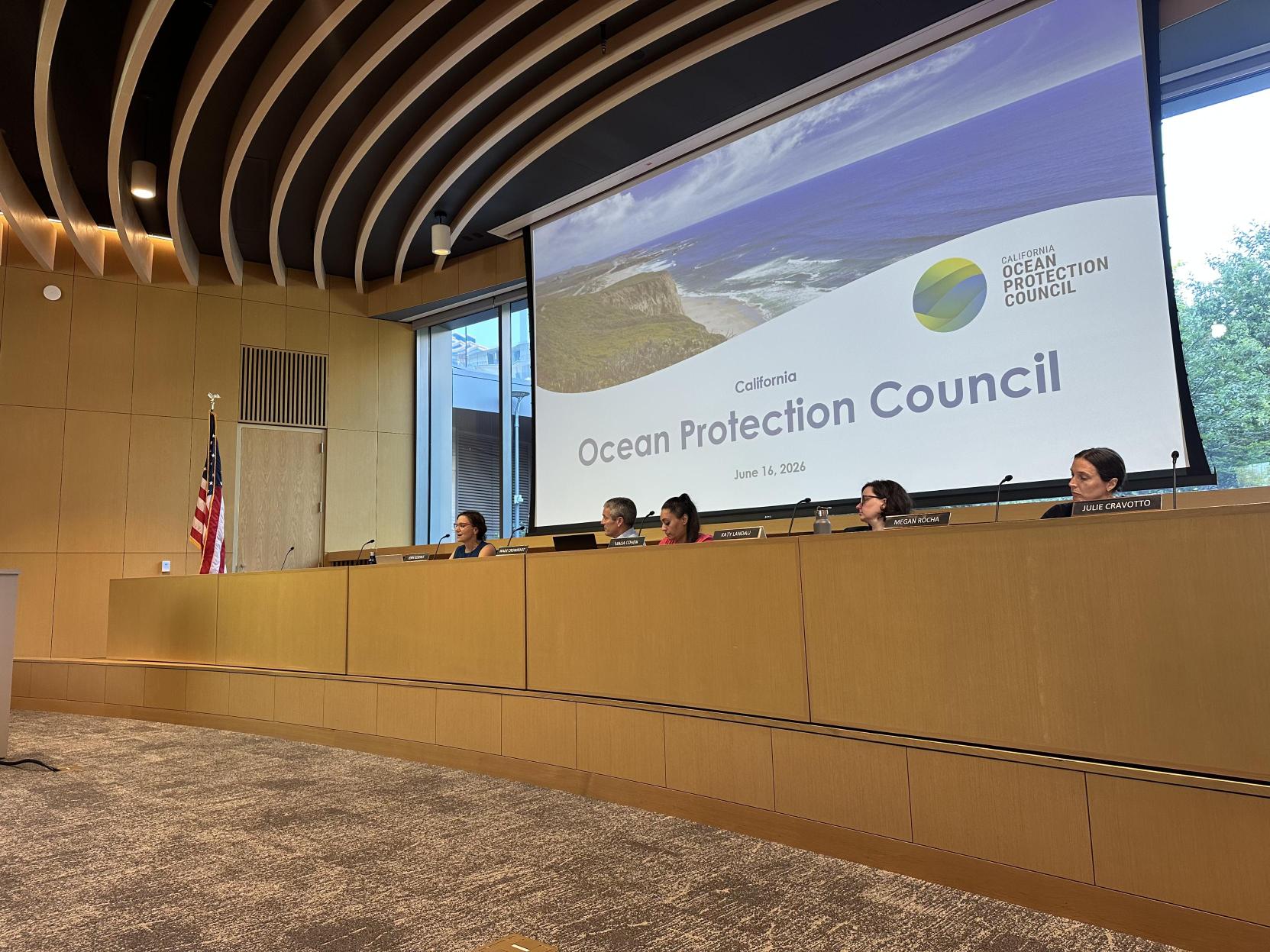
California Natural Resources Secretary Wade Crowfoot opened the June meeting by acknowledging that protecting California’s coast and ocean remains a high priority for the state amid dynamic changes at the federal level, including the Trump Administration’s continued push to expand offshore oil production off the California coast and a federal review of California’s Coastal Zone Management Program. He reaffirmed the Council’s continued work to advance offshore wind as part of California’s clean energy future despite federal opposition.
Executive Director Jenn Eckerle highlighted California’s acceptance this past April as the largest subnational government admitted into the International Union for Conservation of Nature (IUCN), the world’s largest environmental network. She also reported on the West Coast Ocean Alliance’s annual meeting in Ventura, where the Alliance finalized a new strategic plan through 2031 focused on regional coordination, tribal sovereignty, and ocean data and science. On marine protected areas, Eckerle noted that OPC’s policy recommendations on pending MPA petitions will now be released ahead of the August Fish and Game Commission meeting, with Commission decisions expected by year’s end.
Eckerle shared personnel highlights: OPC welcomed five 2026 undergraduate summer interns — Alysse Reyes (CSU Monterey Bay), Dorian Marquez (UCLA), Connor Overton (UC Santa Cruz), Emma Kim (UC Davis), and Barron Nguyen (Stanford) — and OPC also welcomed Hallie Brown as Biodiversity Program Manager & Tribal Liaison, along with 2026 Sea Grant Fellows Nate Buchanan (Climate Team) and Justin Funa (Biodiversity Team). Eckerle also thanked outgoing Executive Fellow Fiona Vogler and Climate Action Corps Fellow Emily Majluf, who will conclude their fellowships by the next OPC meeting.
More information is available in the Executive Director’s Report.
View the full June agenda and associated documents on the meeting webpage. The recording is also available.
Next Meeting
The next OPC Quarterly Public Meeting is currently scheduled for Friday, September 18, 2026, from 12:00 p.m. to 4:00 p.m., at the CNRA Auditorium (715 P Street, Sacramento) with Zoom participation available.
Subscribe to our email newsletter to stay updated on Council meetings, events, job opportunities, and other ways to get involved and stay informed!