
With a Landmark Report and Historic Investments, California Doubles Down on Ocean Health
FOR IMMEDIATE RELEASE
March 24, 2026
CONTACT:
Stacy Hayden, Communications Manager
California Ocean Protection Council
stacy.hayden@resources.ca.gov
As federal rollbacks threaten ocean protections, California is strengthening its commitment to a healthy coast and ocean for all
SACRAMENTO — At a time when federal actions are putting coastal waters and public lands at risk, California is moving in the opposite direction. Yesterday, the California Ocean Protection Council (OPC), in partnership with the California Ocean Science Trust, released the 2026 California Coast and Ocean Report – the first comprehensive, science-based assessment of coastal and ocean health in California history. The report describes not only the pressures facing California’s coast and ocean, but also the historic progress that our state is making to support resilient marine ecosystems and thriving coastal communities.
The Council also approved over $6 million in funding for nine key science and restoration projects that support healthy oceans and advance the state’s goal to conserve 30% of its coastal waters by 2030. Scientific research projects will help identify biodiversity “hotspots” to prioritize for conservation, while restoration work will bolster biodiversity in eelgrass, estuary, and kelp forest ecosystems impacted by climate change, wildfire, and other threats.
“California’s coast and the Pacific Ocean define who we are Californians,” said California Secretary for Natural Resources Wade Crowfoot. “Now for the first time, the state of our coast and ocean is summarized in a clear and compelling way for all Californians to understand. Our new Report explains that while our coast and ocean is generally healthy, climate change and other stressors threaten coastal communities and ecosystems. That’s why we’re doubling down on action-oriented science and restoration and resilience projects along our vast coastline. We’re 100% committed to a keeping our coast and ocean healthy, clean, and accessible for generations to come.”
California’s Coast and Ocean: A Story of Pressure and Progress
The first-of-its-kind 2026 California Coast and Ocean Report assesses 14 key indicators of coastal and ocean health across three themes: People, Wildlife and Habitats, and Stressors. Developed through a partnership between OPC and the California Ocean Science Trust, with expert input from more than 120 scientists, this report distills complex scientific data into easily understandable snapshots focused on status and trends, actions that the state is taking, and how a changing climate may impact ocean health in the years to come.
Indicators were chosen by scientists based on understandability, data availability, and relevance to state management and policy priorities. Together, the indicators tell a story of both pressure and progress – while California’s coast and ocean are generally healthy, climate change is increasingly threatening species, habitats, and ecosystem services, and the state is taking action to protect both people and nature in a changing world.
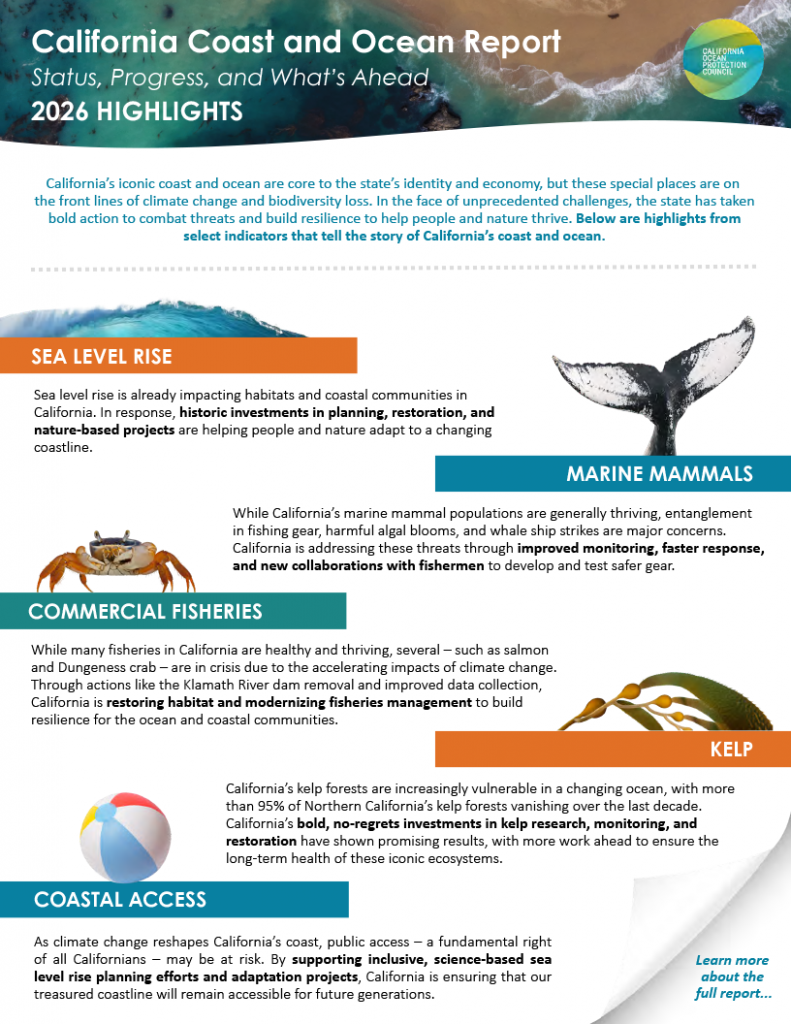
Key findings from the report include:
People
- Most beaches in California have excellent water quality, though a few problem sites persist. One of the most sophisticated beach safety systems in the country is giving swimmers across the state advance warning if water quality is predicted to be poor.
- As climate change reshapes California’s coast, public access – a fundamental right of all Californians – may be at risk. By supporting inclusive, science-based sea level rise planning efforts and adaptation projects, California is working to ensure that our treasured coastline will remain safe and accessible for future generations.
- While many fisheries in California are healthy and thriving, several that the commercial fishing sector relies on – such as salmon and Dungeness crab – are in crisis due to the accelerating impacts of climate change. Through actions like the Klamath River dam removal, restoring flow and habitat in our rivers, and improved data collection, California is restoring habitat and modernizing fisheries management to ensure climate readiness.
Wildlife and Habitats
- Most fish species in California have healthy, abundant populations. Decades of science-based catch limits, California’s statewide network of marine protected areas, and habitat restoration projects have helped once-threatened species recover.
- Overall, marine mammal populations in California are healthy. However, entanglement in fishing gear remains a major threat to California’s whales. Working with fishing communities, the state is developing and testing new “whale-safe” fishing gear to prevent entanglement-related deaths.
- California’s kelp forests have been decimated by a changing ocean, with more than 95% of Northern California’s bull kelp vanishing over the last decade. California’s bold, no-regrets investments in kelp research and restoration are working to bring kelp back from the brink.
Stressors
- Sea level rise is already impacting coastal communities and habitats in California. Historic investments in planning, restoration, and nature-based projects are helping people and nature adapt to this changing coastline.
- Seawater off California’s coast is six times more corrosive to marine life than before the widespread use of fossil fuels. By committing to ambitious carbon emission reduction goals, California is directly addressing the problem driving ocean acidification.
- In 2024, shellfish harvesting advisories or closures related to harmful algal blooms impacted 8 of the 15 coastal counties in California. These blooms can also lead to marine mammal strandings and deaths. California has developed a proactive bloom monitoring program, and when marine mammals are stranded, state-funded rescue and rehabilitation teams respond.
The report shows that through targeted investments, science-based management, and strong collaboration with local communities and California Native American tribes, OPC and its partners are helping to build resilience. And the stakes couldn’t be higher, as a healthy coast and ocean is central not only to Californians’ identity, but also to their economic, cultural, and spiritual well-being.
“The Coast and Ocean Assessment was a vital catalyst for our statewide network of scientists to synthesize decades of marine fish data into a cohesive, meaningful message for the public and policymakers,” said Dr. Chris Free, Associate Researcher at the University of California Santa Barbara. “By integrating multiple long-term monitoring programs for the first time, we moved beyond raw data to uncover new insights into California’s rich marine biodiversity. This rigorous process has provided a new benchmark for how we understand and monitor our ocean ecosystems.”
Read the full report at opc.ca.gov/report.
Join the Conversation
Secretary Crowfoot will showcase the 2026 California Coast and Ocean Report at an upcoming Secretary Speaker Series on April 28, 2026.
Investing in California’s Ocean Future Through Action-Oriented Science and Restoration
California isn’t just tracking ocean health – the state is making serious investments in it. The Council’s approval of over $6 million to support transformational research and restoration projects, selected in partnership with California Sea Grant as part of a highly competitive process, will advance California’s goal to conserve 30% of its coastal waters by 2030 (the “30×30” initiative) and directly support a healthy coast and ocean.
Action-oriented, two-year research projects will focus on identifying hotspots of biodiversity – areas that are exceptionally rich in species, but also highly threatened – to prioritize for conservation through the 30×30 initiative. For example, a project led by researchers at the University of California Santa Cruz will use cutting-edge modeling techniques to identify climate refugia, or future safe harbors, for nearly 30 important marine species.
In parallel, restoration projects will help improve biodiversity in coastal and marine ecosystems associated with 30×30 Conservation Areas. These projects include kelp and eelgrass restoration in the Channel Islands, reintroduction of endangered white abalone to Southern California’s rocky reefs, removal of invasive species from dune ecosystems near the Humboldt Bay National Wildlife Refuge, and the development of a recovery plan for marine protected areas along the Malibu coastline that were impacted by the Palisades Fire.
Projects selected through a third funding track focused on tribally-led stewardship will be recommended to the Council for approval in June 2026.
Learn more about OPC’s 30×30 efforts at opc.ca.gov/30×30.
About the California Ocean Protection Council
OPC is a cabinet-level state agency that leads California’s efforts to protect and conserve coastal and ocean ecosystems for the benefit of current and future generations. Learn more at opc.ca.gov.
California’s Conservation Leadership in Action
The Golden State is leading the nation in protecting its natural resources. Through California’s 30×30 initiative, a commitment to conserve 30% of the state’s lands and coastal waters by 2030, California added over 1 million acres of conserved land and waters in a single year. That’s larger than the entire state of Rhode Island.