Slowing Down for Whales: How California Is Making Its Busiest Shipping Lanes Safer
Every spring, gray whales (Eschrichtius robustus) travel north along the California coast, mothers and calves making a 12,000-mile round trip between their winter calving grounds in Baja California and their Arctic feeding grounds. These same waters carry an enormous volume of the world’s trade. Container ships, tankers, and bulk carriers travel day and night through some of the most biologically rich ocean on the planet, and the overlap has consequences.
In 2025 alone, there were 26 gray whale strandings recorded in the San Francisco Bay Area, and nine of them were suspected or probable vessel strikes, according to the Marine Mammal Center. Ship strikes are also a leading threat to endangered blue, fin, and humpback whales. The Protecting Blue Whales and Blue Skies program (BWBS) has been working to reduce California’s ship strikes, while improving air quality for coastal communities, for more than a decade.
Protecting Blue Whales and Blue Skies Program
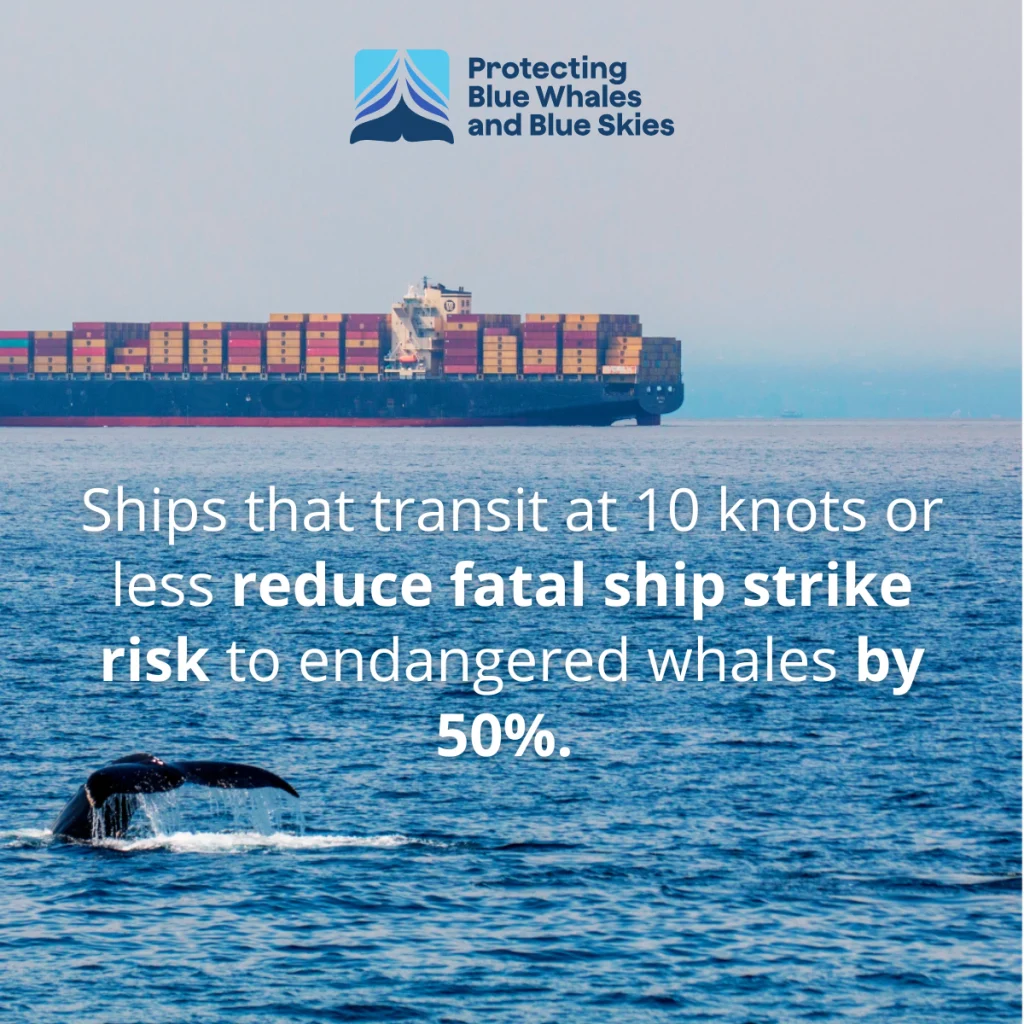
The program asks large oceangoing vessels of 300 gross tons or more to voluntarily slow to 10 knots or less through designated zones along the California coast, covering whale feeding grounds, migration corridors, and other areas where ships and whales are most likely to overlap. Research shows that vessels traveling at 10 knots reduce the risk of a fatal whale strike by approximately 50%.
Slowing down also improves coastal air quality and reduces underwater noise pollution, which disrupts how whales communicate and navigate. Participating vessels reduce their underwater radiated noise pressure by approximately 38%.
Cooperation is voluntary, with shipping companies recognized for high participation through positive press and award recognition. Between 2018 and 2025, 76 companies participated with over 700 individual vessels participating in recent years.
On Earth Day April 22, 2026, BWBS held its annual awards ceremony near the Port of Oakland, recognizing the 787 participating vessels that traveled over 481,000 nautical miles at whale-safer speeds of 10 knots or less in 2025 – an increase of over 40 vessels from the 2024 season. The ceremony honored Assemblymember Gregg Hart for his leadership and support for the program through the passage of Assembly Bill 14 and honored top performers from the 2025 Season, including the award of the Sustained Leadership Award to the Mediterranean Shipping Company, recognizing the world’s largest container line as the most consistent, top performer in the 11-year history of the BWBS program.. A full list of 2025 Season award recipients is available on the BWBS website.
The 2026 season launched on Earth Day, April 22 and ends December 31, 2026.
A New Law Expands the Program Statewide
The program began in 2014 along the Santa Barbara Channel and expanded over the following decade. In October 2025, Governor Newsom signed Assembly Bill 14, authored by Assemblymember Gregg Hart, making California the first state in the country to strengthen a voluntary vessel speed reduction program through state law. In 2026, the program announced an expanded zone to cover the entire California coastline for the first time, from the Oregon border to the Mexican border and further offshore to protect biologically important whale habitat that prior zones did not reach. The inclusion of this new statewide zone is currently optional, with the opportunity for individual shipping lines to opt into the expanded zone. Assembly Bill 14 also establishes Ocean Protection Council (OPC) as a formal stakeholder and advisor to the program.
OPC’s Role in the Partnership
The program is led by a coalition of partners that includes the California Marine Sanctuary Foundation, the National Oceanic and Atmospheric Administration’s Office of National Marine Sanctuaries, California county air district agencies, and the Benioff Ocean Science Laboratory. Under Assembly Bill 14, OPC participates in the program as an advisor and has engaged in briefings with the United States Navy, United States Coast Guard, the United States Environmental Protection Agency, and the maritime sector, helping identify state priorities and broaden the program’s reach.
This work advances OPC’s 2026-2030 Strategic Plan, which commits OPC to supporting the program’s expansion through 2030 as a priority action to reduce whale vulnerability to ship strikes.
What the Science Is Telling Us About Gray Whales
Most of California’s marine mammal populations are stable or increasing, but gray whales are a serious concern. Populations have dropped nearly 40% since 2019, with the most recent count estimating only about 13,000 animals. Calf counts are at record lows. Scientists point to changes in Arctic feeding grounds, where warming temperatures have reduced prey availability, leaving malnourished whales more vulnerable to hazards along their migration route, including ship traffic.
Programs like Protecting Blue Whales and Blue Skies cannot address the root causes of gray whale decline, including a warming ocean. But they can reduce one of the direct threats these vulnerable and already declining animals face as they travel through California waters.
What You Can Do
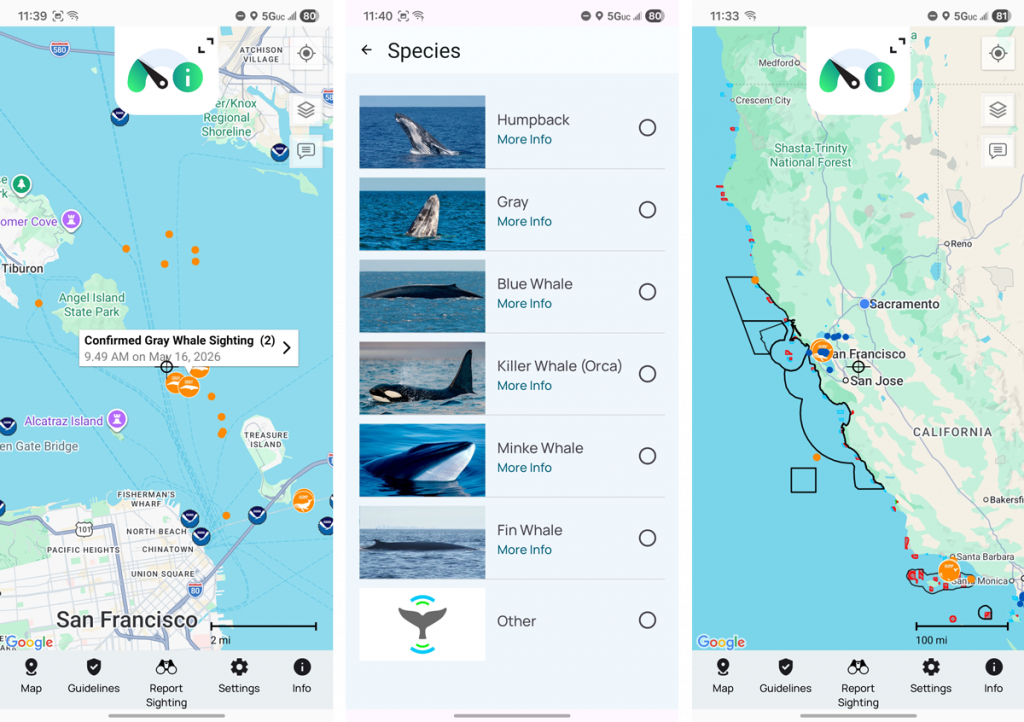
If you spend time near the water this spring, the Whale Alert app lets you report whale sightings in real time, feeding data to ship operators and scientists to support safer routing. If you import goods or work with brands that do, the Protecting Blue Whales and Blue Skies Ambassador Program connects businesses with participating shipping lines. More than 30 companies are already ambassadors.

Learn More
Marine mammals are one of 14 indicators in the 2026 California Coast and Ocean Report, which draws on the best available science from more than 120 researchers to document the pressures facing California’s ocean and the investments and actions making a difference.
Read the full Marine Mammals indicator and explore all 14 indicators at opc.ca.gov/report.