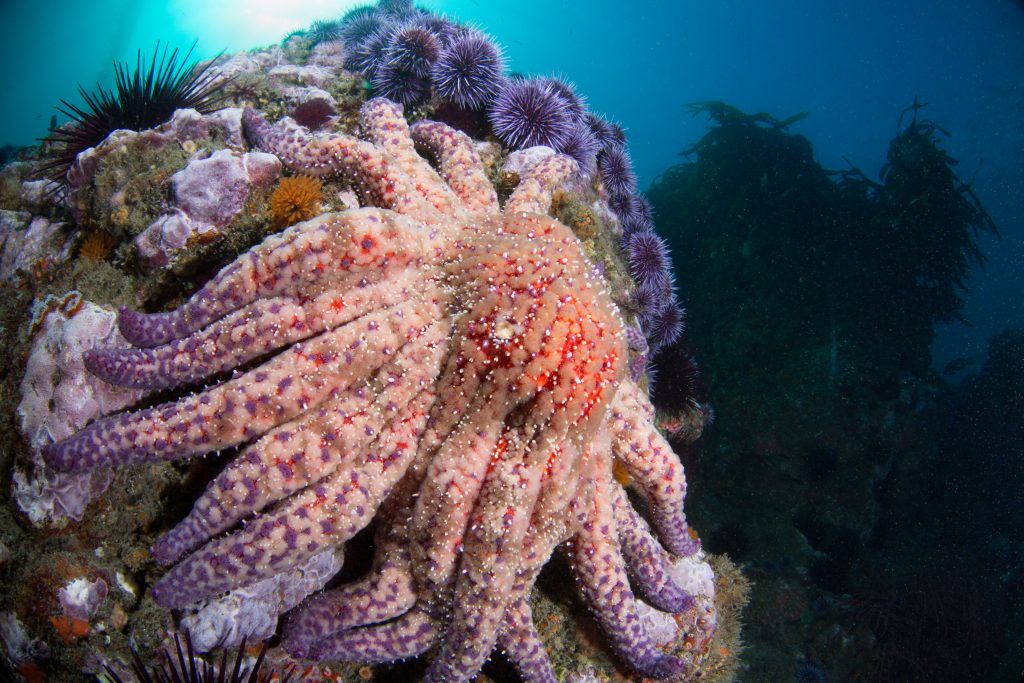

Bringing Back the Stars: California’s Effort to Rescue the Sunflower Sea Star
Just beneath the surface of California’s coastal waters, a recovery story is unfolding. It connects a once-abundant sea creature, the collapse of underwater forests, and a coalition of scientists, divers, and community members working to turn the tide.
Meet the Sunflower Sea Star
The sunflower sea star (Pycnopodia helianthoides) is one of the ocean’s most remarkable animals. The largest sea star in the world, it can span more than three feet across, sport 16 to 24 arms, and move at a surprising three feet per minute. An active hunter, it preys on sea urchins, clams, snails, and other invertebrates. Once abundant from Alaska to Baja California, it was a dominant predator on California’s rocky reefs, keeping purple sea urchin populations in check and kelp forests healthy.
A Disease That Decimated a Species
In 2013, a catastrophic outbreak of sea star wasting disease swept the Pacific Coast, killing an estimated six billion sunflower sea stars — nearly 95% of the global population. In California, the species is now considered functionally extinct in much of its former range. The outbreak of sea star wasting disease and loss of sunflower sea stars coincided with an unprecedented marine heatwave (2014-2016), negatively impacting rocky reef ecosystems and ultimately resulting in a 96% loss of kelp canopy across California’s north coast.
The loss of any keystone predator can have cascading effects on the ecosystems it once shaped. Sunflower sea stars played a critical role in maintaining balance on California’s rocky reefs, and their dramatic decline has left a void in the food web. Scientists are still working to fully understand the downstream effects, but the disappearance of a dominant predator often allows prey populations to shift in ways that reshape entire habitats. Restoring the sunflower sea star is not just about saving a single species; it is about restoring the ecological relationships that healthy coastal ecosystems depend on.
A Breakthrough and a Path Forward
In summer 2025, a landmark study from the Hakai Institute in British Columbia identified the bacterium Vibrio pectenicida as a cause of sea star wasting disease, a pivotal discovery reshaping recovery efforts. Scientists at the California Academy of Sciences, The Nature Conservancy, and the Sunflower Star Laboratory in Moss Landing have achieved unprecedented success raising juvenile sunflower sea stars in a collaborative captive breeding program. A recent “soak” experiment in Monterey Bay showed promising results when captive-raised stars were placed in cages in the ocean. Research divers have also begun spotting wild sunflower sea stars in Sonoma and Mendocino counties, marking the first verified sightings in years and suggesting that some individuals may carry natural resilience to the disease.
OPC’s Investment in Recovery
At its September 30, 2025, Council meeting, OPC approved over half a million dollars to advance sunflower sea star reintroduction through a partnership with The Nature Conservancy, the California Academy of Sciences, and the California Department of Fish and Wildlife. The funding supports three interconnected areas of work:
- Captive breeding and genetic diversity: The Nature Conservancy, working with researchers at institutions along the coast, will coordinate disease-resilience studies and help draft best practices for next steps to advance the captive breeding program and the potential reintroduction of sunflower sea stars. Researchers will also investigate whether disease resilience can be passed from parent to offspring, a key question for long-term recovery.
- Wild population search and environmental DNA monitoring: In partnership with the California Academy of Sciences, community scientists will help search California’s coast for wild sunflower stars using iNaturalist and water sampling tools. A new environmental DNA tool developed by the National Oceanic and Atmospheric Administration allows researchers to detect sunflower stars and the sea star wasting disease pathogen from water samples alone, dramatically expanding the scope of monitoring.
- Disease testing and pathology capacity: Funding to the California Department of Fish and Wildlife’s Shellfish Health Lab at Bodega Marine Laboratory will support a dedicated scientist to test for Vibrio pectenicida in California’s waters and in wild-caught sea stars, ensuring that any future reintroduction efforts are grounded in rigorous disease biosecurity.
You Can Help
Everyday Californians have a role to play. The California Academy of Sciences hosts the Solstice Sea Star Search each June and December solstice, inviting community scientists to look for sunflower sea stars in tidepools and upload sightings to iNaturalist. Every observation helps researchers track where wild stars still exist and where recovery may be taking hold. Recovery will take time, but there is hope on the horizon.